What happens when the strong one needs support?
When the dependable one doesn't have anything left to give?
Or when the person who always has it together… doesn't?
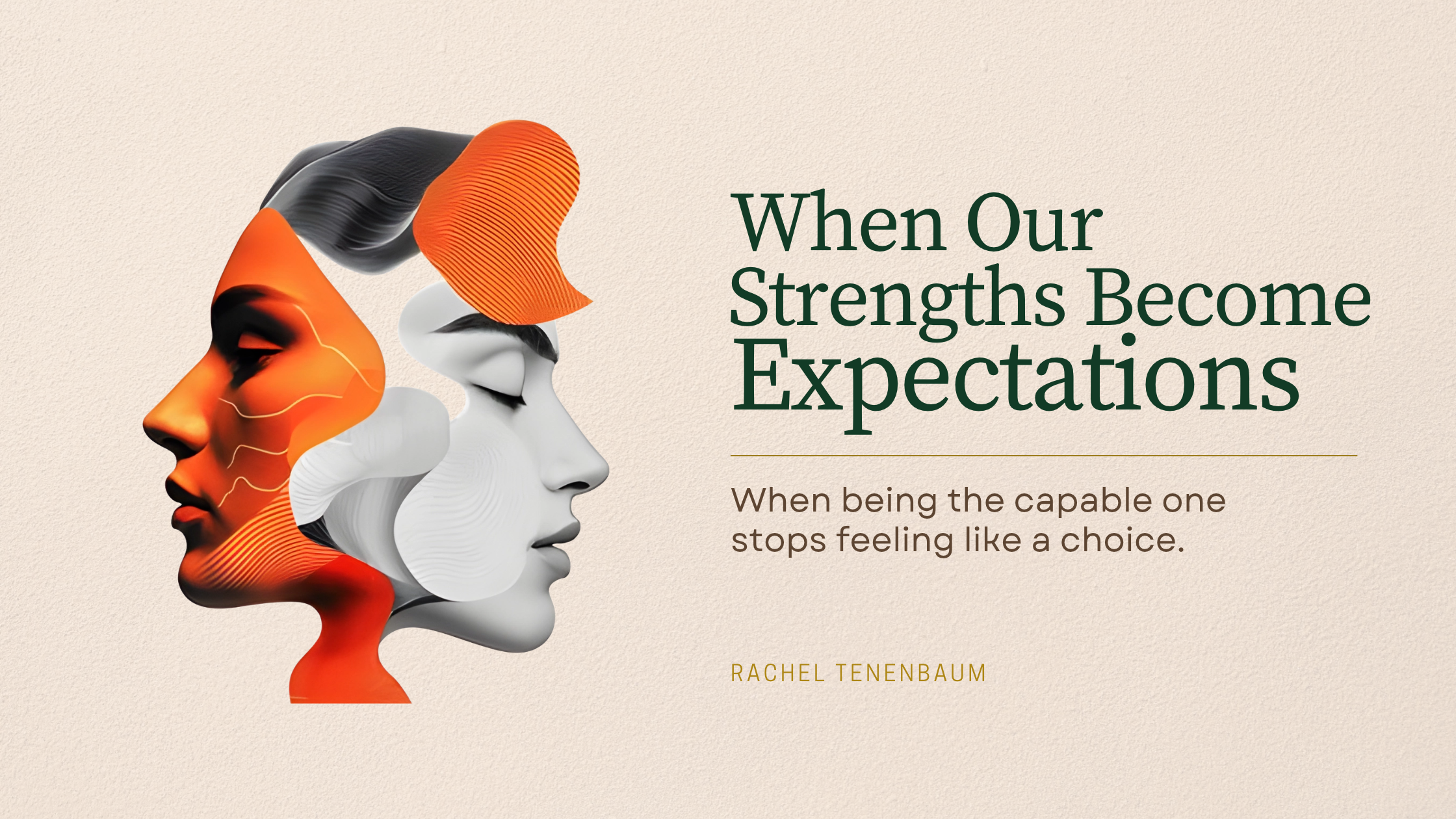
Something that started as a description of who we are can quietly become a rule about how we're expected to show up.
Every. Single. Time.
Our brains love patterns and categories. They help us make sense of ourselves and the world around us. And there's comfort in knowing who we are.
Until we don't feel like that person on a particular day.
I LOVE people. Truly. I love connecting with them, bringing them together, and facilitating spaces where incredible things can happen.
And there are days when I don't want to talk to a single human being. 😂
For years, I sometimes felt the need to explain that.
To make sure someone knew I was normally more outgoing. More talkative. More available.
As though I needed to reassure them, and perhaps myself, that I really was the outgoing, people-loving person I'd always believed myself to be.
I've noticed something similar with rest.
I need a good eight or nine hours of sleep to feel my best. Yet I used to look at people thriving on six or seven and wonder why I couldn't do the same.
Instead of honoring what worked for me, I was measuring myself against an expectation I'd adopted from somewhere else.
And I wonder how much energy we spend trying to prove we're the person we've always believed ourselves to be.
I’ve noticed this with so many of the leaders I work with.
The one who's always been known as the strong one and struggles to ask for support.
The person everyone depends on who feels guilty when they need something themselves.
The high achiever who can't quite admit when they've reached their capacity.
And often, the expectation isn't even coming from someone else anymore.
We've become the ones holding ourselves to it.
Maybe being strong earned us praise. Being agreeable kept the peace. Being productive made us feel accomplished.
Over time, those qualities became part of how we understood ourselves. And when we can't live up to them, it can feel surprisingly unsettling.
If I'm not the strong one today, who am I?
If I can't do everything I normally do, what does that say about me?
And when our sense of who we are gets challenged, we can find ourselves working even harder to prove we're still who we thought we were.
A quality that has served us incredibly well can become something that limits us when we decide we must always demonstrate it.
Our independence can make it difficult to ask for help. Our dependability can make it difficult to disappoint someone. Our ability to push through challenges can make it difficult to recognize when we need to stop.
But what if we didn't have to prove those qualities every day?
What if we could meet ourselves where we actually are, rather than constantly measuring ourselves against where we think we should be?
Some days we have tremendous capacity. Other days, we have less.
And I've learned that the more I work with myself rather than fight myself, the more energy I have for the things and people that matter to me.
This isn't about abandoning our values, lowering our standards, or avoiding our responsibilities.
It's about recognizing that how we show up on any given day doesn't have to become a referendum on who we are.
So the next time you catch yourself thinking:
“But I'm normally not like this.”
“I should be able to handle this.”
“That's just not who I am.”
Perhaps there's an opportunity to stop measuring yourself against who you think you're supposed to be and get curious about who you are in that moment.
What do I actually need today, and am I willing to work with myself rather than against myself?
If this reflection resonated, I'd love to continue the conversation.
Whether through a guided meditation, leadership coaching, a keynote, or another reflection, my hope is always the same:
To help you lead and live with greater clarity, presence, and possibility.
Explore what's next →